
Type-Specific Flight Controls For Aircraft Simulators

Specify bespoke next-generation flight simulator controls for fixed-wing, rotary-wing and AAM/eVTOL aircraft types. Active/passive. 

Contact Us

Specify Custom Flight Controls

Designing and manufacturing fully bespoke active flight simulator controls – tailored precisely to a specific aircraft type – is one of the most complex and specialised engineering challenges in the field. It requires deep experience in aerodynamics, control systems, mechanical design, electronics, human factors and certification.

World-class simulator controls specialist Stirling Dynamics excels in this complex work, designing and manufacturing fully bespoke next-generation simulator controls for aircraft including the CH-47 Chinook and CH-53 King Stallion helicopters. We are the sole supplier of these controls on the $1.7 trillion F-35 program.


Contact us to discuss your requirements

Overcoming The Design Challenges

Bespoke active flight controls built to simulate a particular aircraft must replicate not only the geometry and ergonomics of the real controls but also the exact ‘feel’ of the aircraft’s force-displacement behaviour, its aerodynamics, its trim characteristics and its dynamic response.

Unlike generic simulator controls, bespoke solutions require an intimate understanding of the aircraft’s control mechanics, flight-control laws and pilot perception. This work demands deep experience because every aircraft type behaves differently – and these differences must be reproduced with very high levels of precision.
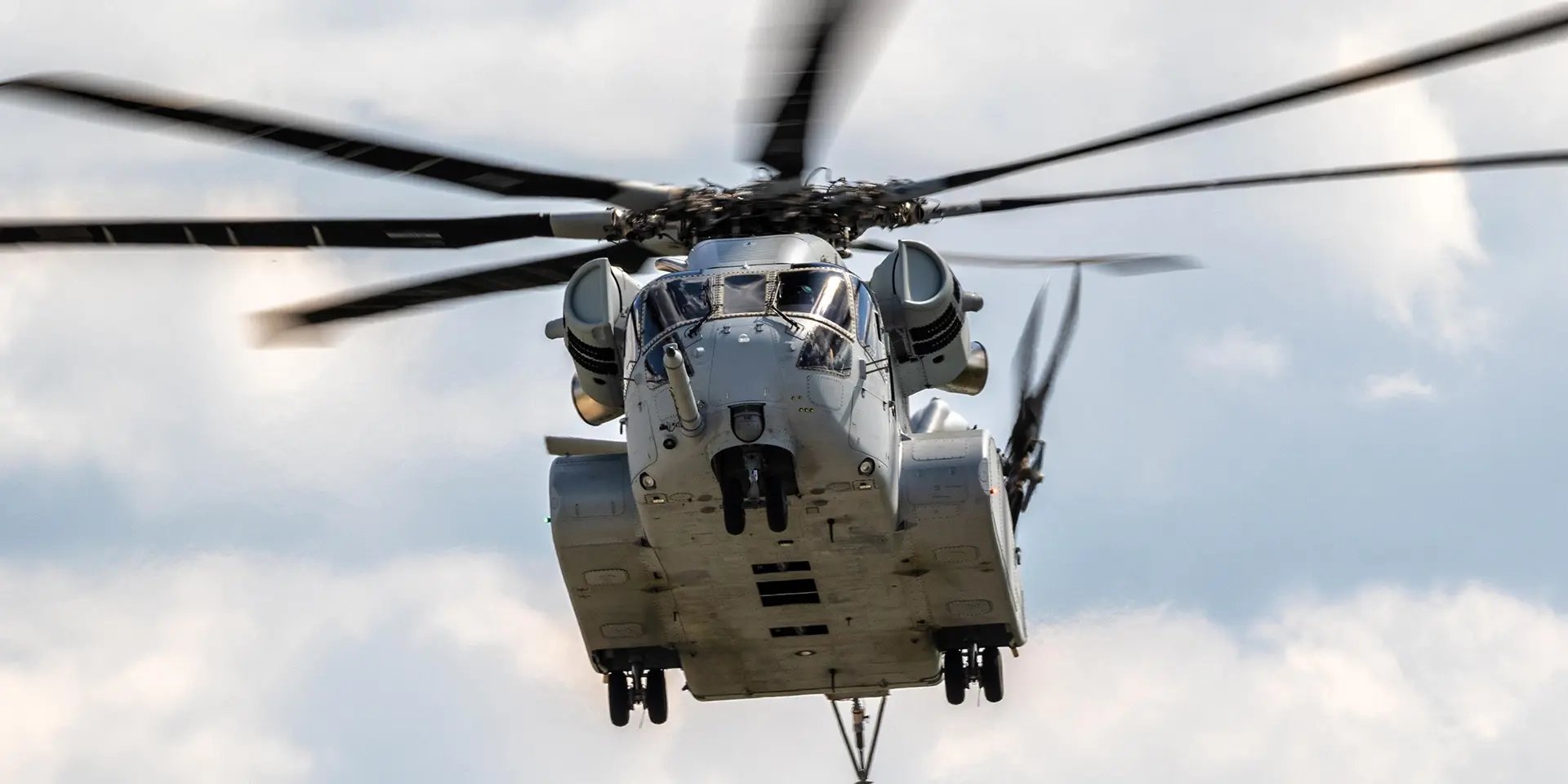
Stirling-Dynamics-CH-53K-Type-Specific-Pilot Contorls

Replicating True Feel Law

A simulator must reproduce the same stick or yoke forces, gradients, breakout characteristics, hydraulic effects, trim behaviour and loading variations that the pilot feels in the real cockpit.

This depends heavily on flight-test data which is often proprietary or sensitive – meaning that our simulator flight control engineers must work closely with the OEM, use partial or derived information, or combine modelling with iterative pilot tuning.

The requirement is not simply to match numbers on a page but to recreate the perceptual fidelity of the aircraft. Achieving correct feel typically means matching forces and dynamics within a few per cent of the actual aircraft across the entire flight envelope. This alone requires years of specialised expertise.

Achieving Mechanical Fidelity

The physical controls – whether a yoke, cyclic, side-stick, collective or pedals – must replicate the aircraft’s geometry, travel limits, ratios and tactile features precisely. Even a small deviation in travel angle or linkage geometry can meaningfully alter the pilot’s perception of aircraft handling.

Bespoke controls often require custom machining, high-tolerance bearing assemblies, specialised linkages and detailed ergonomic replication based on cockpit measurements. They must also be durable, maintainable and consistent in performance over thousands of hours of continuous use.

Reproducing The Aircraft’s Dynamic Behaviour

This involves high-speed, closed-loop control of electric actuators with update rates in the hundreds or thousands of hertz. The controls must enable the system to render changing force cues accurately and smoothly – without oscillation, instability or undesirable buzzing. The system must also remain stable across the wide variations in human neuromuscular impedance: it must feel natural whether a pilot has a light touch or a heavy hand.

Achieving robust dynamic stability while maintaining high bandwidth and low latency requires advanced control theory expertise, high-quality sensors, careful actuator selection and sophisticated real-time software. This is an area where only experienced teams succeed consistently because the interactions between human and machine can be subtle and highly non-linear.

Integrating Bespoke Flight Controls

Electrical and electronic integration adds another layer of complexity. Active controls require high-power servo drives, dual-channel sensing for safety, robust EMI management and fast communication with the host simulator. Fail-safe behaviour must be guaranteed at all times. The controls must never ‘run away’ or generate forces outside safe limits. This means implementing watchdog systems, redundancy, hardware torque limiting and comprehensive fault monitoring. 

As a result, the electronics and software must be built to aviation safety standards. This requires specialist hardware and experienced control engineers familiar with both simulation and safety-critical systems.

Certification

A bespoke active control system must meet regulatory standards such as EASA CS-FSTD(A) or FAA Part 60. These fidelity standards require stringent validation, documentation, accuracy measurements and correlation with aircraft data. Passing qualification tests often involves dozens of measurements and subjective pilot evaluations. 

A system cannot succeed unless the engineering team is experienced in compliance processes and understands how regulators interpret realism and acceptability criteria.

Sustainable Fidelity

Bespoke systems must be built to aerospace-grade mechanical tolerances, with minimal friction, minimal backlash and very low reflected inertia. Any friction or mechanical imperfection in the control path will degrade the perceived realism. 


Maintaining this level of fidelity over years of heavy use requires the optimum design of linkages and bearings and the correct specification of materials – as well as calibration methods that ensure the device’s accuracy does not drift. Manufacturing demands not only precision machining but deep practical experience of how simulator controls wear and behave over time.

Holistic Precision

All these aspects must work together seamlessly. Bespoke controls must integrate with the simulator’s visual, motion, aerodynamic and avionics systems without perceptible delay or mismatch. Latency must be kept extremely low, communication must be deterministic, and force cues must remain time-coherent with motion cues.

This calls for high levels of systems engineering expertise and multidisciplinary collaboration based on significant experience of simulators, flight testing and control systems development.

Why Stirling Dynamics

Designing and manufacturing fully bespoke active simulator controls involves mastering aerodynamics, real-time control, mechanical engineering, human factors, electronics, systems integration, safety engineering, certification processes and pilot-perception psychology.

The smallest error in any one area can compromise realism, training value or safety. That is why only specialised teams with many years of experience are able to produce aircraft-specific active controls that offer true high fidelity.

Stirling Dynamics (an Expleo company) is a world-class innovator that pioneered active pilot controls in the early 1990s. Our new Version 4 bespoke controls are driving innovation in type-specific flight simulation.All controls are designed and manufactured at our Bristol UK technical facility.

Expleo is a €1.4 billion group comprising 18,000 innovation-driven experts in 29 countries. It is trusted around the world by brands including Airbus, Dassault Aviation and Spirit Aerosystems.


Contact us to discuss your requirements