



Systems-level Solutions
Certifiable electronic hardware requires more than technical competence: it demands proven credibility, genuine systems-level thinking and the pace to match ambitious aerospace programmes. Stirling Dynamics brings all three together.
Our highly experienced engineers design and develop safety-critical electronic hardware, embedded software and gateware for aerospace and aviation, from initial concept through to DO-254- and DO-178C-compliant delivery. The multidisciplinary team covers electronic hardware systems design, gateware, embedded software, Field Programmable Gate Array (FPGA) design, circuit board assembly, and verification.
We hold invited membership of the DO-254 User Group Europe alongside Airbus, GE Aerospace, Rolls-Royce, Collins Aerospace and Honeywell. Our specialism in electromechanical actuators, inceptors and motor control sits within a systems-level approach spanning DO-254, DO-178C and ARP4754 – so hardware, software, gateware and safety are addressed together rather than reconciled at the end.
Rigorous hardware-in-the-loop verification and an integrated consultancy team – including engineers with prior GE Aerospace certification oversight experience – de-risk programmes early.
The result is a smaller, single-site team that moves with real agility while enhancing performance and safety, typically taking a DO-254-compliant electromechanical prototype from concept to demonstrated hardware in around 18 months.
A Seat at the Table on Airborne Electronic Hardware Standards
Our membership of the DO-254 User Group Europe is by invitation only and it keeps us current with evolving guidance while giving us a genuine voice in how the standard develops. For our customers, it is a visible marker of the depth of our DO-254 expertise and our standing among the organisations that shape this discipline.
DO-254 is the certification standard for airborne electronic hardware in civil aircraft, most significantly programmable logic devices such as FPGAs. Certification authorities reference it directly: non-compliance can prevent an aircraft system from being certified. Its counterpart, DO-178C, covers airborne software, from flight control computers through to cabin systems. Military programmes have historically not mandated DO-254 but we are seeing steadily increasing voluntary adoption as customers recognise the quality and safety benefits it brings, even outside civil certification requirements.
Clarity Where It Is Most Needed: Gateware, Firmware And Software
The most common misconception we encounter is a blurring of PLD programming, or gateware, with either conventional software or physical electronics. The distinction matters because it determines which standard applies, and getting it wrong early in a programme causes delays later.
- Gateware
- DO-254
- Firmware
- DO-178C
- Higher-level abstract software
- DO-178C
Gateware
Gateware programs the logic fabric of an FPGA directly, using languages such as SystemVerilog or VHDL. It sits closer to hardware than software: it captures sensor signals and produces hardware outputs at a very low level, reconfiguring logic gates rather than executing instructions. Gateware falls under DO-254.
Firmware
Firmware is different again. It is specialised software held in non-volatile memory and executed directly on a microcontroller or CPU, typically written in C or C++. Despite running ‘close to the hardware’, firmware is software and falls under DO-178C, as does higher-level abstract software.
DO-254 itself distinguishes between simple hardware, which receives comparatively light scrutiny, and complex hardware, where indeterminate logic paths mean it must be treated with the same rigour as software. That scrutiny increases further with Design Assurance Level, up to DAL A for the most safety-critical functions.
Electromechanical Systems Are Where We Do Our Best Work
- Electromechanical actuators
- Inceptors
- Motor control
Our particular specialism is the rapid, bespoke development of electromechanical airborne electronic hardware, compliant with DO-254 to the highest DAL levels. We work extensively on electromechanical actuators and inceptors, the flight control sticks and actuation systems that sit at the centre of safety-critical flight control, and on the motor control that drives them.
This is deliberately not treated as a hardware problem in isolation. Compliant, certifiable electromechanical systems demand a genuinely systems-level approach spanning DO-254, DO-178C and ARP4754 systems safety standards together. Many organisations treat DO-254 as a standalone workstream, and that is a significant source of programme delay and cost overrun.
Our team combines model-based design, simulation, mechanical engineering and electronic hardware development under one roof so that safety, algorithms, electronics, mechanics and motor control are considered as a single interconnected system from the outset – not reconciled at the end.
Being a smaller, integrated team working from one location gives us a genuine advantage here: knowledge transfers directly between projects, decisions are made quickly and we can move faster than larger, more dispersed organisations without compromising on rigour. It is also why we can typically take a DO-254-compliant electromechanical prototype from concept through to demonstrated hardware in around 18 months.
A Development Approach Built For Certification, Not Just Innovation
We combine a formal V-model development process, requirements-driven through design, implementation, verification and validation, with Agile iterative loops that inform and refine those requirements as a design matures. Certifiable systems cannot be developed on Agile methods alone but used well within a formal structure, they reduce risk and speed up prototyping considerably, following a spiral approach where uncertainty narrows as the design progresses.
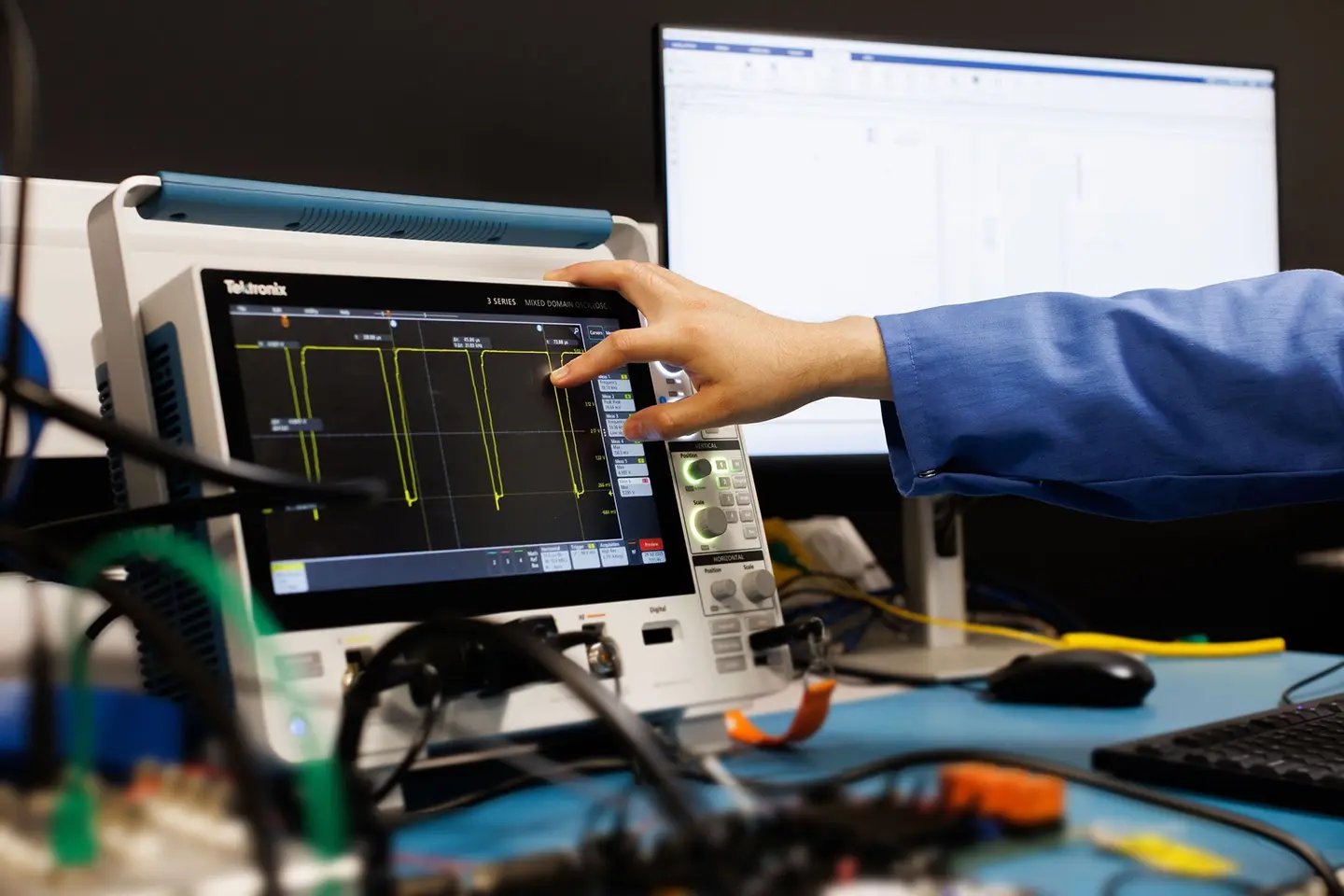
We back this with investment in serious verification infrastructure, including Speedgoat hardware-in-the-loop equipment for power-in-the-loop and hardware-in-the-loop simulation. This lets us simulate full electromechanical system connections and test across the range of system states well before physical integration, materially de-risking a programme. It is the same class of tooling used by organisations such as Rolls-Royce and a level of investment that is unusual for a company of our size. This reflects how seriously we take verification rigour, rather than treating it as an afterthought.
Our consultancy team, which includes engineers with prior certification oversight experience at GE Aerospace, also advises customers directly on DO-254 compliance and certification strategy, independent of hardware development, helping programmes to navigate the standard’s more abstract requirements and associated advisory circulars with confidence.
We have applied this approach across established aircraft programmes and emerging eVTOL prototypes alike, where new entrants are often building DO-254-compliant hardware development processes from scratch to keep pace with rising avionics complexity.
Bring Us Your Hardest Challenges
Every airborne electronic hardware programme carries its own combination of pressures: certification timelines that cannot slip; safety-critical requirements that leave no room for shortcuts; increasingly complex systems that demand real engineering judgement rather than a standard playbook.
Whether you are navigating DO-254 compliance for the first time, integrating electromechanical actuation into a new platform, or you simply need a partner who can move at the pace your programme demands without cutting corners on rigour, our team has the depth of knowledge and the track record to help.
From early advisory conversations through to hardware-in-the-loop verification and certification support, we work alongside your engineers as an extension of your team, not a distant supplier.
Steven Griffin-Santos CEng MIET
Software and Electronics, Technical Manager
The Software & Electronics Engineering team excels in creating safety-critical electronics & embedded software for aerospace applications. We design and develop airborne electronics and software, ensuring they meet certification standards i.e., DO-178C, DO-254 and DO-160.
Our multidisciplinary team includes engineering specialists in Electronic hardware systems and design, embedded software & verification, Field Programmable Gate Array (FPGA) design & verification, and Circuit Board Assembly (CBA) requirements verification.